 English
 Español


Gentle
Gentle
Gentle
Gentle
Gentle
Gentle
Gentle
Gentle
Gentle
Content
- 1 Drying Is the Step Most Shops Skip
- 2 Cold Bending or Hot Forming: Choose by Radius, Not by Habit
- 3 Matching Forming Method to Part Geometry
- 4 The Hidden Metric: Delayed Cracking, Not Visible Defects
- 5 Where Formed Polycarbonate Actually Ends Up
- 6 A Selection Sequence That Avoids Rework
- 7 Maintenance, Cleaning, and Compliance Notes
A 3 mm polycarbonate sheet comes off the vacuum former with a milky haze and a line of small bubbles along the deepest draw. The operator blames the mold. Most of the time the cause sits upstream: the sheet picked up moisture in a humid warehouse and never went through a drying oven before it met the heaters.
Forming polycarbonate sheet comes down to three numbers — moisture content, sheet temperature, and bend radius. Control those and PC behaves predictably through cold bending, line heating, vacuum forming, and pressure forming. Ignore them and you get blisters, crazing, and parts that crack three weeks after they ship.
The short version
- Dry polycarbonate sheet to below 0.02% moisture before any hot forming step.
- Cold bending needs an inside radius of roughly 100 to 200 times sheet thickness.
- Hot forming runs between 150 °C and 190 °C; above 200 °C the sheet blisters and yellows.
- Anneal finished parts at 120 to 125 °C to release internal stress before inspection.
Drying Is the Step Most Shops Skip
Polycarbonate is hygroscopic. It does not grab water the way nylon does, but a sheet stored in a humid warehouse absorbs enough to cause trouble. Once the sheet passes roughly 150 °C, that trapped moisture flashes into steam inside the polymer. The visible result is internal bubbles, silver streaking, and a surface haze that polishing cannot remove.
The working target is a moisture content below 0.02%. A circulating-air oven set to 120 °C gets most production sheets there:
Sheet thickness
Drying time at 120 °C
Practical note
2 mm
2 hours
Comes up to temperature fast; avoid over-drying
3 mm
3 hours
Typical diffuser and light guide stock
5 mm
4 hours
Add a soak period; core lags behind the skin
8 mm
6 hours
Verify with a contact probe, not an infrared gun
Two habits keep drying effective. Never stack sheets tightly in the oven — air has to move across both faces or the core stays wet. And move the sheet from oven to forming station within minutes, because a dried sheet starts reabsorbing surface moisture within 15 to 30 minutes in humid shop air. A long queue in front of the machine quietly undoes the whole step.
Cold Bending or Hot Forming: Choose by Radius, Not by Habit
Start with the geometry. If the tightest inside radius you need is more than about 150 times the sheet thickness, cold bending at room temperature is faster, cheaper, and safer for optical surfaces. If the radius is tighter than that, or the part is a three-dimensional shape rather than a single fold, you have to heat the sheet.
Cold bending in practice
Polycarbonate tolerates far more cold forming than acrylic, but it still has a floor. The conservative rule is a minimum inside radius of 200 times thickness; experienced fabricators push toward 100 times for short-term bends that will never see sustained load. A 3 mm sheet bent to a 600 mm radius is comfortable. Force the same sheet to 200 mm and it holds shape at first, then crazes along the outer surface weeks later.
Springback on cold bends runs 5 to 10 degrees depending on thickness and radius. Overbend by that margin, or design a mechanical fixing that locks the final angle instead of trusting the material to stay put.
Hot forming temperature windows
Polycarbonate softens around 147 °C, which is why every hot process starts above that line. Below it, the sheet does not yield — it cracks.
Sheet temperature
Process
Outcome
Below 145 °C
Attempted hot bend
Cracks or whitens at the bend line
150 - 165 °C
Line and free bending
Good shape memory, radii down to 1-2x thickness
170 - 190 °C
Vacuum and pressure forming
Full mold detail; needs support to control sag
Above 200 °C
Overheating
Blisters, yellowing, uncontrolled drawdown
Heat both faces evenly. A single-sided heat source puts the sheet in tension on one surface and compression on the other, and the imbalance shows up as a bow that survives cooling. For line bends, heat along a band roughly three to four times the thickness wide, not a narrow stripe.
When the formed part has to stay clear, the base sheet matters as much as the press settings. Optical-grade transparent PC stock engineered for thermoforming holds its clarity through the heat cycle instead of hazing over.
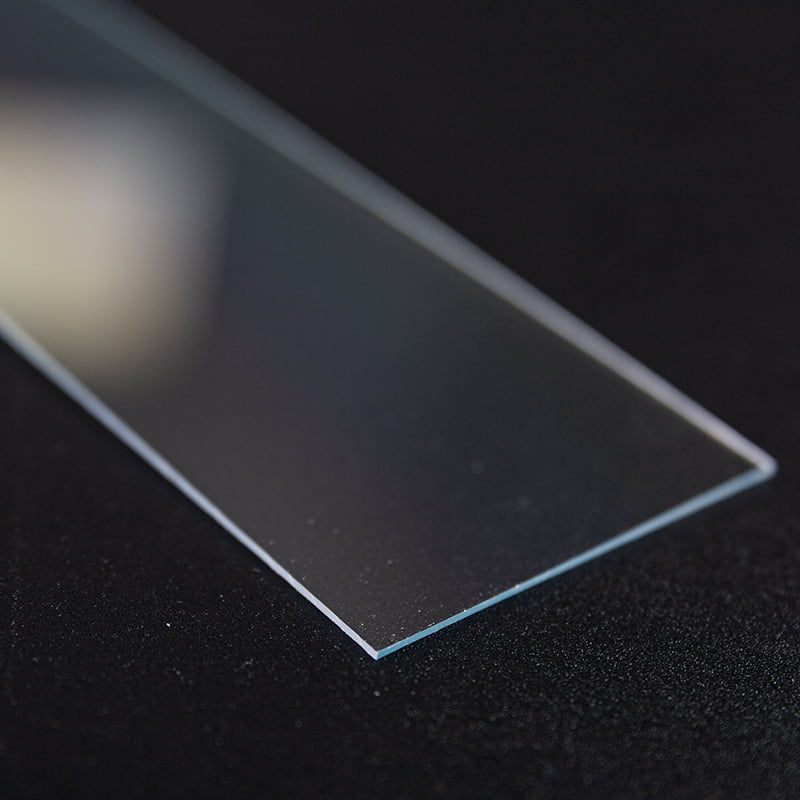 Optical-Grade Transparent Polycarbonate Sheet for Thermoformed Clear PartsIdeal when formed clarity matters: this optical-grade, impact-resistant, flame-retardant PC sheet supports 0.5–3 mm glazing, lighting, and display applications.View Product →
Matching Forming Method to Part Geometry
Once the sheet is dry and the temperature window is known, method selection is mostly about draw depth, surface requirement, and cycle time. Each process trades tooling cost against detail and repeatability.
Vacuum forming
Heats to 175 - 190 °C and pulls the sheet onto a single mold with atmospheric pressure. Cheapest tooling, moderate draw ratios, and the workhorse for diffuser covers, trays, and machine guards.
Pressure forming
Adds positive air pressure on the back side. Sharp mold detail, better wall-thickness control, and the right choice when the formed part carries a visible texture or tight corner radii.
Line heating and bending
Localized strip heating at 155 - 165 °C, then a controlled fold. Best for single-axis bends in signage, partitions, and folded enclosures where the flat surface must stay optically clean.
Blow molding and drape forming
Used for deep, gentle curves and long-format components. Slower cycle, but lower tooling stress and fewer witness marks on the heated surface.
Where the formed part is structural rather than decorative, the sheet grade does the heavy lifting. Impact-resistant solid PC stock in multiple thicknesses absorbs the drop test that a standard sheet fails after forming thins the walls.
 Impact-Resistant Solid Multi-Thickness Polycarbonate Endurance SheetChoose for structural formed parts exposed to impact; solid PC in 1–20 mm offers UV, weather, and shatter resistance.View Product →
The Hidden Metric: Delayed Cracking, Not Visible Defects
Incoming inspection catches bubbles and haze. What it does not catch is the residual stress that turns into a stress crack three months into service, usually at a fixing hole or a tight bend. Tracking warranty claims per 1,000 formed parts tells a clearer story than any visual check.
Cold bent,
no anneal
42
no anneal
42
Cold bent,
annealed
6
annealed
6
Vacuum formed,
dried + annealed
11
dried + annealed
11
Vacuum formed,
undried
68
undried
68
The pattern in representative fabricator data is consistent: annealing matters more than the forming method itself. A cold-bent part that never saw an oven performs worse in service than a vacuum-formed part that did. Stress relief, not process glamour, decides whether a formed PC component survives its warranty period.
Where Formed Polycarbonate Actually Ends Up
Demand for formed PC sheet is not evenly spread. Lighting and light management dominate, followed by construction and signage, with automotive and industrial guarding taking the rest. That distribution explains why forming parameters for diffusers and light guides get the most attention in production planning.
- Lighting diffusers and light guides: 38%
- Building glazing and partitions: 24%
- Signage and displays: 16%
- Automotive and transport: 12%
- Machine guards and industrial windows: 10%
The lighting share is not accidental. Diffuser and light guide geometry demands tight bend radii, uniform wall thickness after draw, and haze control that no other application enforces. The same material logic carries over into PC and PMMA sheet solutions for modern building projects, where cold bending dominates because the panels are large and the radii are generous.
A Selection Sequence That Avoids Rework
Most forming failures trace back to a decision made before the sheet was ever heated. Work the sequence in order and each step narrows the next one.
- Define the service environment first. Indoor diffuser, outdoor glazing, and machine guard each carry different UV, impact, and flame requirements. This decides the base material before any process discussion.
- Fix thickness from the tightest radius. Divide the required inside radius by 150. If the answer is 2 mm, you cannot specify a 3 mm sheet and expect a cold bend to work.
- Confirm whether the part needs optical clarity after forming. If yes, restrict yourself to optical grades and plan the annealing step into the cycle time.
- Dry, then protect the dry state. Schedule oven capacity against machine capacity so the sheet does not sit exposed between steps.
- Form, then anneal at 120 - 125 °C. Cool slowly, no faster than 10 °C per hour, to avoid reintroducing the stress you just removed.
- Inspect after cooling, not before. Haze, bow, and wall thinning only stabilize once the part reaches room temperature.
Maintenance, Cleaning, and Compliance Notes
A formed polycarbonate part can last a decade or fail in a season, and the difference is usually chemical rather than mechanical. Polycarbonate is sensitive to alkaline cleaners, ammonia, and most alcohol-based solvents, all of which attack the surface and accelerate stress cracking at any point that carries residual load.
- Clean with warm water and a neutral soap using a soft cloth. Rinse and dry with a non-abrasive wipe. Skip glass cleaners entirely.
- Drill and cut with sharp tooling and generous clearance. Tight holes and countersunk fixings are the most common origin points for stress cracks.
- Allow for thermal movement in long panels. Expansion of roughly 0.065 mm per metre per degree Celsius adds up across a full facade or a long light fixture run.
- Check flame and food-contact requirements early. Flame-retardant and food-safe grades differ in formulation, and switching grade after tooling has been cut is expensive.
- Store flat, out of direct sun, with interleaving. Sheets that bow in storage form unevenly no matter how good the oven is.
For lighting components, the finished moulding sometimes makes more sense than forming in-house. A pre-formed flame-retardant PC lampshade removes tooling risk, drying discipline, and annealing control from the equation altogether.
 Custom Multi-Shape Flame Retardant PC LampshadeFor lighting components, this pre-formed polycarbonate lampshade comes in strip, circular, and irregular shapes, removing in-house forming and tooling risk.View Product →
Forming polycarbonate sheet rewards planning more than it rewards equipment. A shop with a used oven, a calibrated contact probe, and a written drying schedule will out-produce a shop with a new pressure former and no moisture control. The three numbers — moisture below 0.02%, sheet temperature inside the correct window, and a bend radius that respects the material — do most of the work.
Add annealing as a fixed step rather than an optional one, and the failure modes that show up months after delivery largely disappear. Parts stop cracking at fixing holes, haze stops drifting upward after the first thermal cycle, and the scrap rate at the forming station stops being a mystery.