 English
 Español


Gentle
Gentle
Gentle
Gentle
Gentle
Gentle
Gentle
Gentle
Gentle
Content
- 1 What “Heat Resistance” Actually Means for Acrylic (PMMA)
- 2 Acrylic vs. Other Optical Sheet Materials: Thermal Comparison
- 3 Hidden Indicator: Thermal Expansion
- 4 Industry Applications: Where Acrylic Heat Resistance Matters Most
- 5 How to Choose the Right Acrylic Grade: A Practical Checklist
- 6 Maintenance, Storage, and Compliance
A lighting engineer once asked us a blunt question: will a PMMA diffuser survive a 12-hour shift inside an enclosed LED panel light where the air around the LED board reaches 85°C? The answer matters because acrylic heat resistance is not a single number. It depends on the grade, the duration of exposure, and the safety margin you build into the design. This guide explains what acrylic can and cannot handle, where the real failure points are, and how to choose the right optical sheet for warm applications.
Key conclusions up front
- Standard acrylic (PMMA) is safe for continuous use up to roughly 65–85°C, depending on grade.
- Softening begins around 100–110°C; visible warping and sagging follow quickly above that range.
- Acrylic does not melt like a crystalline plastic; it softens gradually, so heat damage is preventable with good design.
- For sustained temperatures above 90°C, consider heat-resistant PMMA grades or polycarbonate.
What “Heat Resistance” Actually Means for Acrylic (PMMA)
Acrylic, or poly(methyl methacrylate), is an amorphous thermoplastic. Unlike crystalline polymers, it has no sharp melting point. Instead, it softens gradually as temperature rises, which is why heat resistance is best understood as a set of thresholds rather than one number. Understanding the base chemistry of PMMA material helps explain why those thresholds behave as they do.
Three specifications matter most when evaluating acrylic for a warm environment:
Continuous service temperature
The maximum temperature a sheet can withstand for thousands of hours without significant loss of strength, clarity, or dimensional stability. For standard PMMA this is typically 65–85°C.
Heat deflection temperature (HDT)
The temperature at which a loaded test bar deflects a set amount under 1.8 MPa bending stress. Standard PMMA grades fall in the 75–95°C range; heat-resistant grades reach 95–115°C.
Vicat softening point
Measured with a flat needle under a small load, this reflects the onset of surface softening. It typically sits at 100–108°C for acrylic, which is also the range where thermoforming becomes practical.
Transient heat spikes are more forgiving than sustained exposure. A quick spike to 90°C for a few minutes may be harmless, while holding the same sheet at 80°C for months can cause creeping deformation and stress relaxation. Cast acrylic generally performs slightly better than extruded acrylic at elevated temperatures because of its higher average molecular weight and more uniform chain structure. Extruded sheet remains a good choice for low-heat applications, but if your assembly runs warm, cast or heat-resistant grades are safer starting points.
Acrylic vs. Other Optical Sheet Materials: Thermal Comparison
To see where acrylic stands, compare it with the materials commonly used in lighting, display, and enclosure applications. The values below represent typical commercial sheet grades, not best-case or worst-case data points.
The takeaway is straightforward: acrylic sits above PS but well below PC in thermal capability. If your application involves enclosed LED drivers, industrial lighting, or outdoor enclosures that bake in direct sun, PC deserves serious consideration despite its higher cost.
Hidden Indicator: Thermal Expansion
HDT gets most of the attention, but thermal expansion causes more field failures in optical assemblies than melting ever does. PMMA’s linear coefficient of thermal expansion is roughly 70 × 10-6 per °C. A 600 mm light guide panel will grow about 2.5 mm when the temperature swings from 20°C to 80°C. If the frame does not absorb that movement, the sheet will buckle or stress-crack.
The chart below compares maximum continuous service temperatures for the main optical sheet materials.
PS 70°C
PMMA 80°C
PP 95°C
PC 120°C
Frame design recommendations
- Leave a 2–4 mm expansion gap per metre of sheet length in rigid frames.
- Use floating mounts or rubber gaskets instead of fully constrained edges.
- For applications with wide temperature swings, a PC diffuser sheet is often the safer optical choice.
- Never pre-drill thermal-cycling assemblies without oversizing the holes; allow the fastener to slide.
Industry Applications: Where Acrylic Heat Resistance Matters Most
In our work supplying optical sheets to lighting and appliance manufacturers, thermal risk shows up unevenly across industries. A rough distribution of where acrylic heat performance matters most looks like this.
Thermal risk by sector
- LED lighting (38%) — diffusers, light guide plates, and lens covers sit close to warm LED boards and drivers.
- Architectural panels (22%) — skylights, facade elements, and partitions exposed to solar gain.
- Retail displays and signage (20%) — backlit graphics and showcases with lighting behind the panel.
- Industrial machine guards (12%) — enclosures near motors, pumps, and process heat.
- Other (8%) — automotive, medical, and consumer product components.
An LED diffuser that looks identical to a signage panel may need a completely different thermal specification. In enclosed LED fixtures, standard PMMA can yellow or sag over time, which is why many OEMs switch to anti-yellowing high-hardness PMMA diffuser sheets even when the nominal ambient temperature seems safe.
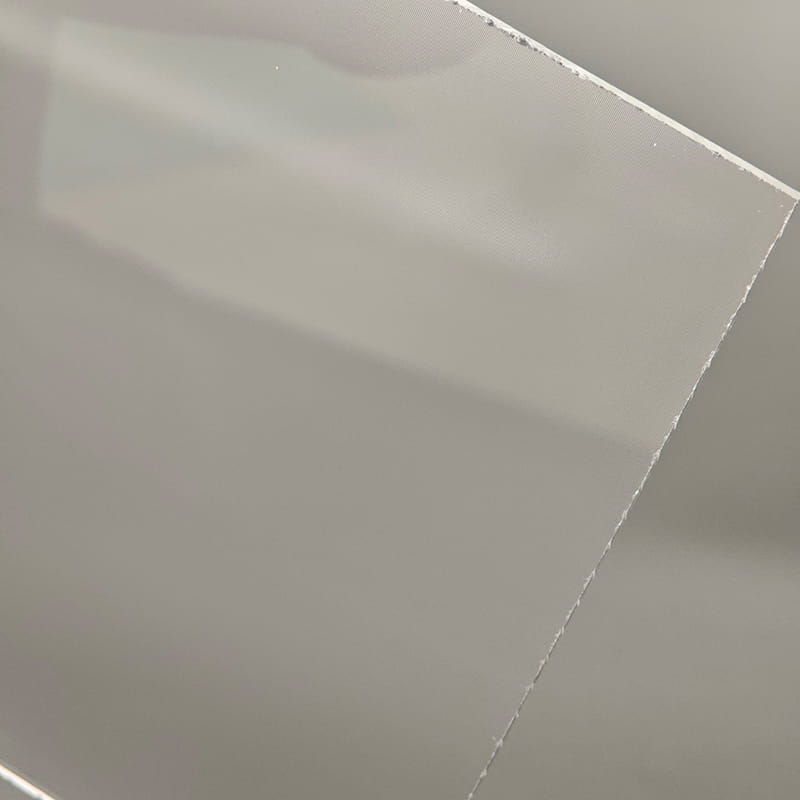 Anti-Yellowing High-Hardness PMMA Diffuser Sheet for Frameless Panel LightsThis optical-grade acrylic diffuser offers superior yellowing resistance and scratch resistance for enclosed LED fixtures, balancing 45% transmittance with thermal stability to prevent sagging and discoloration in warm applications.View Product →
How to Choose the Right Acrylic Grade: A Practical Checklist
Specifying the right sheet means matching thermal load to material capability, then verifying with samples. This is the process we use with customers sourcing light diffuser panel materials for warm applications.
1
Define the real thermal load
Measure ambient temperature, radiant heat from light sources, LED board temperature, and airflow. A sheet in a sealed fixture can run 20–30°C hotter than the room.
2
Compare HDT with peak temperature
Keep at least 15–20°C of margin between the worst-case expected temperature and the HDT of the chosen grade.
3
Account for thermal expansion
Calculate the expected length change over your operating range and design the frame, gasket, or mounting system accordingly.
4
Decide between PMMA and PC
Below 90°C sustained, standard or heat-resistant PMMA is usually the right economic choice. Above that, switch to PC for dimensional stability and impact safety.
5
Validate with prototype testing
Run the actual assembly at worst-case temperature for at least 100 hours. Measure yellowing (YI shift), warpage, and optical transmission before and after.
For lamp shades and fixtures that also need flame-retardant performance, a multi-shape flame-retardant PC lamp shade is a proven fallback when acrylic’s thermal aging is the limiting factor.
 Multi-Shape Flame Retardant PC Lampshade for Indoor and Outdoor FixturesA custom-molded polycarbonate lampshade with flame retardancy and impact resistance, suitable for irregular shapes in diverse luminaires where acrylic thermal aging falls short, ensuring safety and durability.View Product →
Maintenance, Storage, and Compliance
Heat resistance is not only about the material grade; it is also about handling, storage, and cleaning over the service life of the part.
Keep heat sources away
Never mount acrylic directly above a high-wattage lamp, heat sink, or exhaust vent without a baffle. A 50–100 mm clearance is usually enough to keep surface temperature below the safe threshold.
Clean with the right chemistry
Use mild soap and water with a soft microfiber cloth. Solvents such as isopropyl alcohol can cause crazing, especially on panels that have already been thermally cycled.
Store flat and shaded
Keep sheets flat, with the protective film on, away from direct sunlight and heating vents. Angled or edge-loaded storage introduces residual stress that can show up later as warpage.
On the compliance side, standard PMMA is typically rated UL 94 HB, meaning it can sustain burning horizontally but tends to self-extinguish when the flame source is removed. If your application requires a V-0 or 5VA rating, choose a flame-retardant acrylic grade or move to flame-retardant PC. Verify RoHS and REACH declarations with your supplier, because flame-retardant additives can affect both compliance and optical clarity. For products that must survive wide thermal swings, a wide-temperature flame-retardant PC diffuser sheet gives the strongest balance of light transmission and dimensional stability.
 Uniform-Lighting Flame-Retardant Wide-Temperature PC Diffuser SheetThis PC diffuser delivers uniform light diffusion, V-0 flame retardancy, and a -40°C to 120°C range, making it a strong choice for applications needing both compliance and dimensional stability under thermal swings.View Product →
Acrylic heat resistance is not a simple pass/fail test. It is a combination of continuous service temperature, HDT, softening behavior, and thermal expansion that must be matched against the real conditions of your product. Use the thresholds in this article as a starting point, verify with datasheets and prototypes, and do not hesitate to step up to polycarbonate when the temperature climbs beyond what PMMA can comfortably handle.