 English
 Español

Gentle
Gentle
Gentle
Gentle
Gentle
Gentle
Gentle
Gentle
Gentle
Content
- 1 Core Conclusion: When Extruded Acrylic Wins
- 2 How Acrylic Extrusion Works: Core Principles
- 3 Extruded vs. Cast Acrylic: Data Comparison
- 4 Hidden Metrics: Performance Deep Dive
- 5 Industry Application Distribution
- 6 Selection Guide: How to Choose the Right Extruded Acrylic
- 7 Maintenance and Compliance Recommendations
When a lighting engineer is specifying materials for a new LED panel light series, the material choice often comes down to one pivotal question: extruded acrylic or cast acrylic? The extruded version costs less, holds a tighter thickness tolerance, and delivers batch-to-batch consistency. For a production line consuming hundreds of sheets per week, those differences compound quickly into significant cost savings and fewer quality issues.
Core Conclusion: When Extruded Acrylic Wins
For high-volume optical components such as LED panel lights, diffuser panels, and light guide plates, extruded PMMA acrylic is the most practical and cost-effective material. It delivers above 90 percent light transmittance, thickness tolerance as tight as ±0.005 inches, and a significantly lower cost per sheet than cast acrylic. When your application does not face extreme heat or high residual stress, extruded acrylic gives the best balance of optical performance, dimensional consistency, and total cost of ownership.
How Acrylic Extrusion Works: Core Principles
Acrylic extrusion is a continuous thermoplastic forming process. PMMA resin pellets feed into an extruder, where they are melted to roughly 230-260°C and pushed by a rotating screw through a precision die. The molten sheet is then cooled by calendering rollers, which set the final thickness and surface finish.
The fundamental distinction from cast acrylic is that extrusion is purely physical. Cast acrylic starts as a liquid monomer that polymerizes chemically in a mold, yielding slightly better optical clarity and higher heat resistance, but at a much slower rate and a higher price. Extrusion creates continuous sheets with superior dimensional stability and far better economics for volume production. For a deeper look at the base PMMA material and its properties, this background article is useful.
Key Extrusion Parameters That Affect Quality
- Melt temperature: controls flow consistency and optical clarity
- Screw speed: dictates output rate and polymer homogenization
- Die gap: determines thickness distribution across the sheet width
- Roller temperature: affects surface finish and residual stress
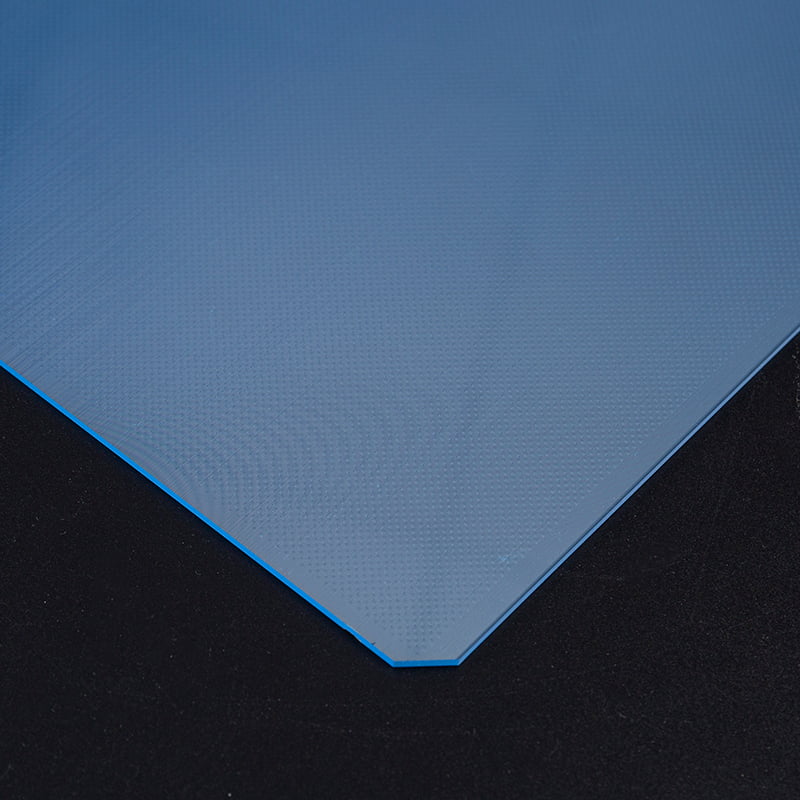 High-Brightness Wide-Application Optical-Grade PMMA Transparent Extruded Light Guide PlateThickness 1-5mm, optical grade.View Product →
Extruded vs. Cast Acrylic: Data Comparison
The differences between extruded and cast acrylic affect procurement, fabrication, and long-term performance. The following comparison reflects typical industry specifications for optical-grade PMMA.
Note: Values are typical for 3mm optical-grade sheet. Actual specifications depend on material grade and supplier.
 Anti-Yellowing High-Hardness PMMA Diffuser Sheet for Frameless Panel LightsThickness 1.2-4mm, 45mm transparency.View Product →
Hidden Metrics: Performance Deep Dive
Beyond surface-level comparisons, four hidden metrics drive most specification decisions. This bar chart visualizes normalized values where higher bars indicate better performance, except for cost where lower is better.
Extruded 92%
Cast 93%
Extruded 15µm
Cast 50µm
Extruded 1.0x cost
Cast 1.5x cost
The larger thickness uniformity of extruded acrylic reduces the need for additional calibration during CNC machining and laser cutting, translating into lower scrap rates and faster production cycles.
Industry Application Distribution
Extruded acrylic is used across multiple sectors. The pie chart below shows the market share distribution based on typical demand patterns observed in the lighting and display industries.
- Lighting (LED panel, backlight, troffer): 38%
- Signage and displays: 24%
- Construction and architecture: 14%
- Automotive components: 10%
- Consumer products: 9%
- Other: 5%
Within lighting, extruded acrylic is commonly specified for plastic diffuser panels and light guide plates, where optical diffusion and uniform luminance are critical.
Selection Guide: How to Choose the Right Extruded Acrylic
Choosing the right extruded acrylic sheet for an application requires evaluation across four dimensions. Use this step-by-step approach to avoid costly mistakes.
Step 1: Confirm Optical Requirements
Define the transmission, haze, and diffusion needs. For panel lights over 85% transmission with 60-80% haze, a matte diffuser grade works well. For backlight modules, a high-transmission transparent grade is required.
Step 2: Evaluate Environmental Conditions
Check maximum operating temperature, UV exposure, and chemical contact. Standard extruded acrylic handles up to 75°C. For outdoor fixtures, use UV-stabilized grades or co-extruded films to prevent yellowing.
Step 3: Match the Fabrication Process
If your process involves laser cutting, CNC milling, screen printing, or vacuum forming, choose a grade with lower residual stress. A surface-hardened option adds scratch resistance for visible surfaces.
Step 4: Calculate Total Ownership Cost
Include material cost, scrap rate from thickness variance, packaging, shipping, and rework. Extruded acrylic often saves 10-20% total cost despite a slightly lower optical clarity than cast.
 4–6H Surface-Hardened Wear-Resistant PMMA Hardened Light Guide Plate4–6H Surface-Hardened Wear-Resistant PMMA Hardened Light Guide Plate features a specialized hard coating treatment that elevates surface hardness to 4H–6H (pencil hard...View Product →
Maintenance and Compliance Recommendations
Proper maintenance preserves optical clarity and extends product life. For extruded acrylic components in lighting or display applications, the following practices are essential.
Cleaning Protocol
- Use a mild soap solution with a soft microfiber cloth.
- Avoid ammonia-based solvents, alcohol wipes, or abrasive materials.
- For anti-static or anti-dust performance, apply a commercial acrylic polish sparingly.
Regulatory and Fire Compliance
When acrylic components are used in public buildings or high-risk environments, specify flame-retardant grades that meet UL94 or equivalent standards. Extruded PMMA can be compounded with halogen-free flame retardants to achieve V-0 or HB classification while maintaining more than 90% light transmission. Certain applications also require RoHS compliance for electronics and REACH registration for the EU market.
Recycling and Disposal
PMMA is a thermoplastic and can be ground and re-extruded. Off-cuts from production should be separated from other resin types to maintain feedstock purity. Many industrial suppliers now offer closed-loop recycling programs for extruded acrylic waste, reducing material spend by 10-15% while supporting sustainability targets.