 English
 Español

Gentle
Gentle
Gentle
Gentle
Gentle
Gentle
Gentle
Gentle
Gentle
Content
What Makes a PS Diffuser Sheet Suited to LED Lighting
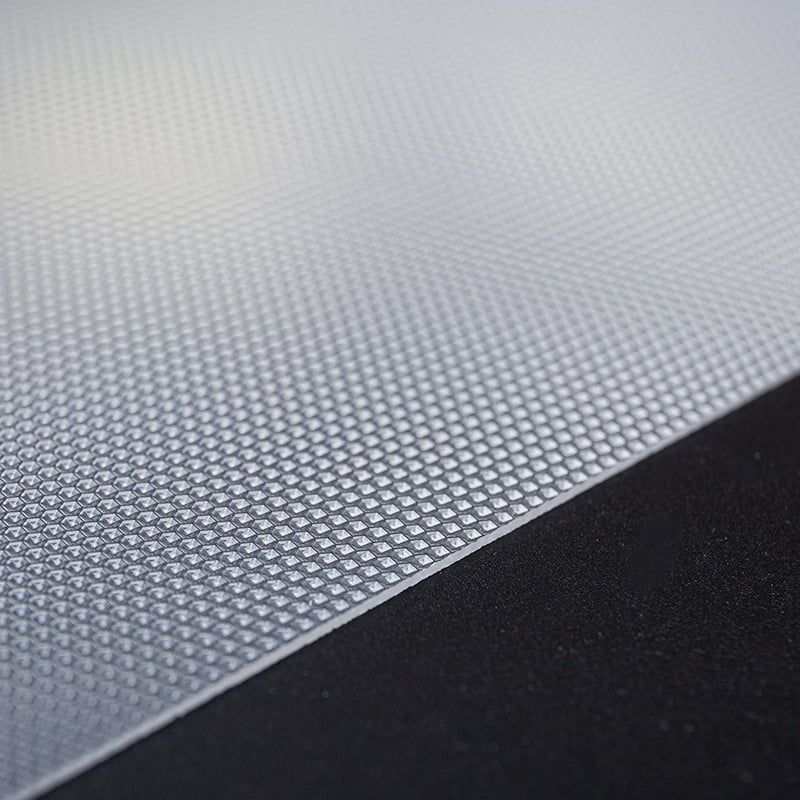
A PS diffuser sheet scatters light from an LED source evenly across a panel while blocking the visibility of individual LED points, and it does this using GPPS (General Purpose Polystyrene) resin formulated for both optical clarity and mechanical stability. The sheet sits between the LED light source and the visible surface of a fixture, softening what would otherwise be a harsh, spotty light output into a uniform glow.
The material choice matters because a diffuser has to satisfy two competing demands at once: it needs to pass enough light through to keep the fixture efficient, while scattering that light enough to hide the LED array underneath. GPPS handles this balance well, with light transmittance of 88% to 92%, a range close enough to glass that fixture designers can achieve bright, even panels without adding extra LEDs to compensate for light loss.
Optical Performance: Transparency and Light Diffusion
Transmittance in the 88-92% range puts GPPS diffuser sheets close to the optical clarity of glass, but with none of the weight or fragility. This matters directly for LED fixture efficiency: every percentage point of transmittance lost is light the LED has to compensate for, either through higher drive current or additional emitters, both of which raise power draw and heat output.
Beyond raw transmittance, GPPS also holds a gloss finish comparable to glass, which affects how a panel looks in the finished fixture — a diffuser with poor surface gloss can introduce visible haze or unevenness even if its transmittance numbers look acceptable on paper.
Dimensional Stability in Real-World Fixture Conditions
LED fixtures run in environments where humidity and temperature swings are constant — bathrooms, outdoor enclosures, and commercial spaces with variable HVAC cycling. A diffuser sheet that absorbs moisture and swells will warp, creating visible waviness or gaps at the fixture edges over time.
GPPS diffuser sheets keep water absorption below 0.1%, which is why they hold their shape in humid environments where lower-grade plastics would deform. Combined with high rigidity, this means a sheet installed flat stays flat, without the sagging that some flexible diffuser materials develop under their own weight across larger panel spans.
Processing Behavior During Fixture Manufacturing
GPPS molds at a temperature of approximately 220°C, a moderate processing point that keeps cycle times manageable for manufacturers producing diffuser sheets at volume. This ease of processing also translates to consistent thickness and surface quality across large production runs, which matters for panel-style LED fixtures where uniform diffusion depends on uniform sheet thickness.
Electrical Insulation for Fixtures Near Electronic Components
Many LED fixtures place the diffuser sheet in close proximity to driver circuitry, PCB traces, or exposed connectors, particularly in flat panel and troffer-style designs. A diffuser with poor insulation properties introduces risk in these tight-clearance layouts.
GPPS offers a volume resistivity of 10²⁰ Ω·cm and maintains stable insulation performance even at high frequencies, making it a safe material choice for fixtures where the diffuser sits adjacent to live electronic components rather than being fully isolated behind a separate barrier.
Key Properties at a Glance
The table below summarizes the core performance characteristics that make GPPS a common choice for LED diffuser applications.
| Property | Value |
|---|---|
| Light transmittance | 88% – 92% |
| Molding temperature | Approx. 220°C |
| Water absorption | Below 0.1% |
| Volume resistivity | 10²⁰ Ω·cm |
Where This Material Fits Best
GPPS diffuser sheets are a strong fit for flat panel lights, troffers, downlights, and sign-lighting applications where consistent light spread, dimensional stability, and safe proximity to electronics all matter simultaneously. Fixture designers working in humid or temperature-variable settings — bathrooms, outdoor canopies, cold storage lighting — benefit most from the low water absorption, since it avoids the panel distortion that shortens the usable life of lower-grade diffuser materials.
- Confirm transmittance rating matches the fixture's target lumen output without over-driving the LEDs
- Check water absorption specs for fixtures installed in humid or outdoor environments
- Verify insulation resistivity for designs placing the diffuser close to driver circuitry
- Request sheet thickness tolerance data for large panel or troffer applications